Interview with a Judges Award winner: Phil Coffey, Founder, Coffey Architects 

We take an in-depth look at The Tannery, a project by Coffey Architects, which combines mixed-tenure homes, creative workspaces and public art infrastructure. This not only won in the Development of the Year (20–100 Homes) category of the last edition of the British Homes Awards but also contributed to success in not one but two Judges’ Awards:  Architect of the Year as well as the Judges’ Award For Excellence.

Phil Coffey founded his eponymous architecture practice over twenty years ago. Since then, Coffey Architects has developed a portfolio of projects spanning masterplanning, urban design, retrofit and more, in sectors such as education, civic, workplace and residential. 

At the 2025 British Homes Awards, the practice won Best Community Living for Cobham Bowers, a later living community in Surrey and Development of the Year (20–100 Homes) for The Tannery. Both projects contributed to Coffey Architects being named Architect of the Year 2025, as well as The Tannery also clinching the Judges’ Award For Excellence. The latter was praised for distinguishing itself through its exemplary design and execution, and representing a benchmark for residential architecture.


Q: The judges were particularly impressed with The Tannery being a 'culture shaped' development, chiming nicely with your 'designing for people's delight' philosophy - to what extent was this part of the brief and can you walk me through the journey with the client in this regard?

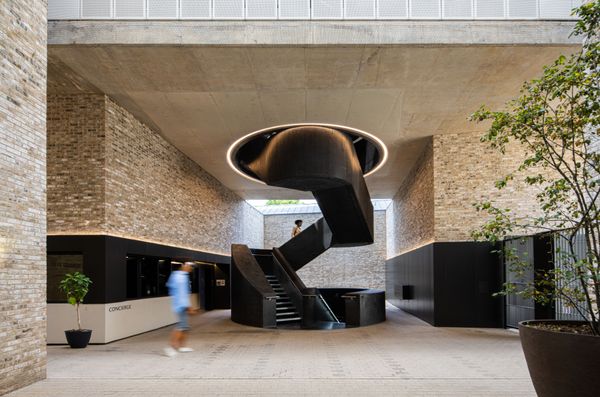
PC: “For our client, London Square, we worked on the masterplan for The Tannery alongside AHMM. Initially, there were a series of studios which made up the Drawing Room, and were housed in one of the existing buildings on the site. We’ve achieved a total rejuvenation of the site to make it the cultural quarter it is today, by relocating the studios into a bright and light-filled warehouse space and is close to the entrance and public spaces which activates the entire area.”

Q: Can you go into more detail about the ground floor uses that connect the local streets and connect with the local urban grain - what was important here structurally and in terms of materials, finishes etc?


PC: “It’s an interesting project because it’s a backland site to a certain extent. You don’t have any roads running through it; instead, there’s a series of public and private courtyards with a predominance of brick. With an entrance off Grange Road, the purpose-built gallery lines the welcoming route into the neighbourhood. 

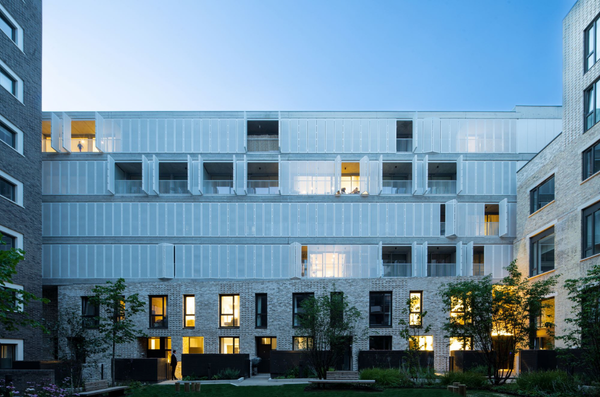
The driver here is really the larger existing buildings, which are part of the site's industrial heritage. They have distinct, robust qualities with quite tall walls, so when we were looking at our scheme, we needed to bring something to match that in terms of scale and robustness on all levels. But we also wanted to do something different, which is where the idea of making the building out of, in essence, white shutters, comes from: to allow the light in.

That idea of ‘cloaking’ buildings can be seen in a variety of our other projects, starting with the Science Museum and the British Film Institute Library, taking in the likes of the Digi Tech Factory in Norwich and 22 Handyside Street in London’s King’s Cross and smaller projects such as St Patrick's School Library.

We have this belief that light is important in architecture. Materially, what we’ve tried to create at The Tannery is a ‘light bar’ that sits across this brick plinth, which holds some townhouses on the ground floor, respecting its listed neighbours to the North and East. These components lead through to a public courtyard along New Tannery Way and a private landscaped courtyard for residents.”


Q: The judges also praised the 'strong landscaping' - tell me more about that, especially as provision of greenery is also central to your practice?

PC: “There are several different tactile experiences when walking through the site: one is the lightness of the entrance from both directions, and second, as you come through the site, a sense of calmness as you’re surrounded by nature in various scales and textures, particularly with the use of harder surfaces in the public spaces and softer ones in the private spaces, for reasons such as maintenance. There are a series of thresholds that take you into the landscaped gardens, which are quite family driven. The landscape architect worked with logs to create natural objects to climb on, which also helps with sales of course, as potential buyers see an opportunity for children to get outside and play.”


Q: Why is it important for architects to enter (and win!) awards?


PC: “It’s great to get awards for what you’ve done but the most important thing about awards is what you can get to do because you win them; it’s a growth strategy. We’ve already seen some impact from winning in the British Homes Awards for instance. It’s good for client recognition, it’s good for the team and it’s good for future work.”

Q: In your opinion, what issues will shape the housing sector in 2026?

PC: “On the supply side, inflation seems to have steadied a bit and, on the demand side, interest rates are continuing to have an impact. We’re hoping that as interest rates drop; that demand will come back. In general, we've been talking to a lot of housing developers recently, and the last couple of months have been a bit more positive; I think there's an awful lot of pent-up demand in the market.”