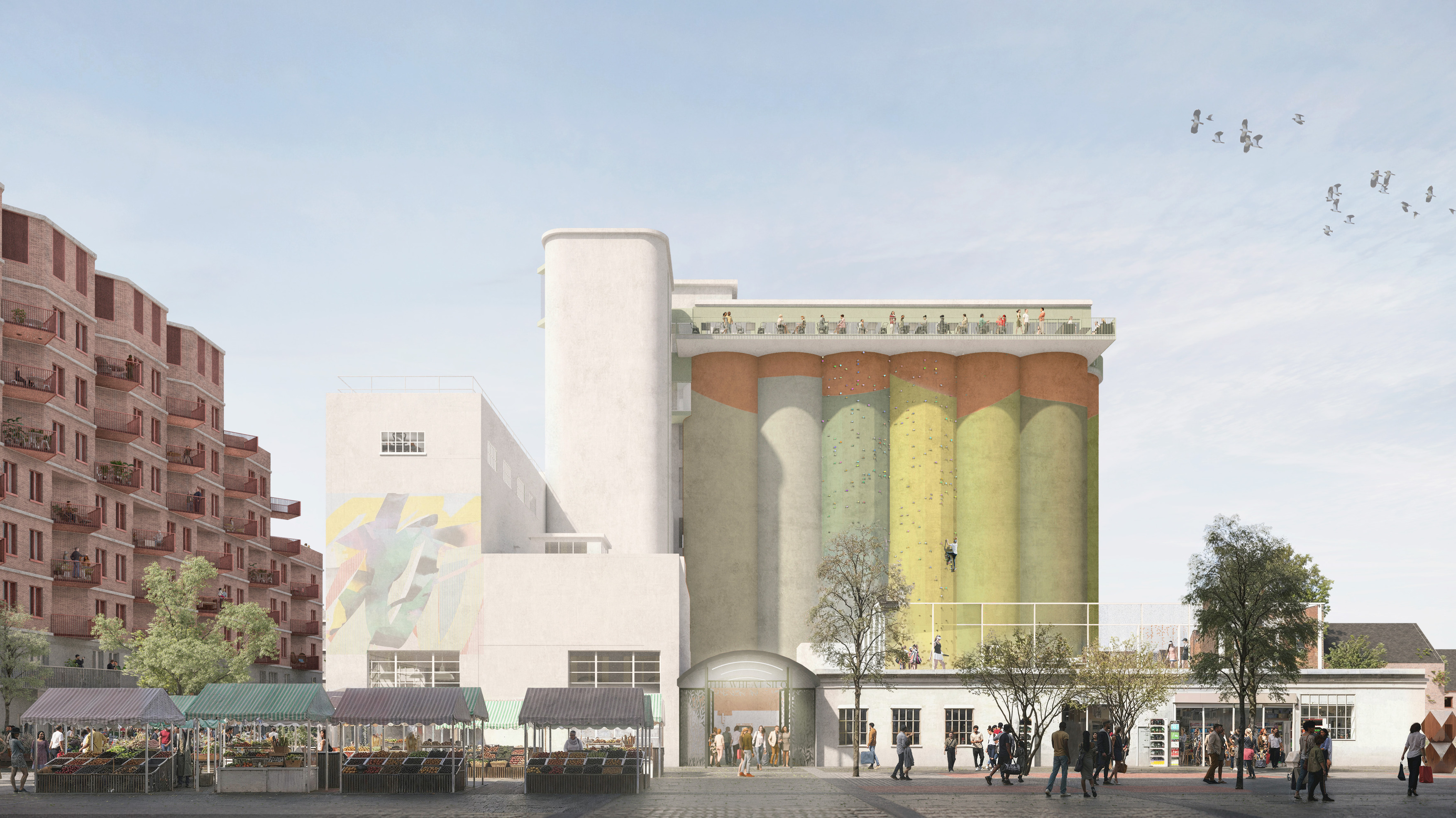
railway as constraints, we’ve embraced them, turning the silos into a climbing wall and leisure space, creating tree-lined boulevards, generous public spaces like play areas, and introducing sustainable infrastructure and nature.
On the other end of the scale, is our beautiful scheme Dace Road in Hackney Wick. Here, we delivered 144 affordable homes alongside flexible commercial spaces for independent businesses, bringing life and employment opportunities into the heart of the community. The design focuses on wellbeing, biodiversity, and shared spaces like terraces and courtyards, blurring the lines between live/work and public/private. We also incorporated Passivhaus principles to reduce heating and cooling loads
And if I look back at our retrofit work, the Textile Factory project is a beautiful example. I love the bridge connections we used to transform and connect two buildings that formed the former Burberry factory into 86 apartments.
For us, whether it’s a large masterplan or a smaller infill site, the goal is always the same: it’s all about creating sustainable, inclusive communities where people feel at home.”
Q: What did you take from your experience as a judge in the 2025 British Homes Awards?
BY: “The British Homes Awards are such a brilliant celebration of design and innovation and what I love most is seeing the sheer variety of projects, the different scales, ambitions and approaches. What I took away this year was a real sense of ingenuity. Rising construction costs have clearly impacted many projects, yet the creativity and problem-solving on display were inspiring. I was particularly struck by schemes that achieved exceptional design on very limited budgets; there are so many beautifully creative and innovative ways to solve design problems.”
Q: Why is it important for architects and designers to enter awards?
BY: “I think awards are so important because they’re not just about recognition, they’re about sharing ideas and showing what’s possible. They capture the creativity and ingenuity in our industry and you learn so much from them. Residential design is such a varied and exciting typology and seeing submissions across all scales really reinforces that. They’re a chance to share your work, celebrate the profession and give architects and designers that moment of recognition for all their hard work.”
Q: How would you like to see the residential sector evolve in 2026?
BY: “That’s a tough question! The residential sector has evolved so much over the past decade, with constant legislative and regulatory changes. Honestly, I’d love to see some stability in 2026 because right now there are so many challenges just to get a project to the drawing board. Looking ahead, I think we need to embrace all forms of living, whether that’s private homes, co-living, or some of the new typologies that are emerging so everyone has a safe, affordable place to live. Understanding and accepting this mix of living will help us deliver the homes we need which means thinking beyond the building itself and looking at the social infrastructure, active ground floors, green spaces, and walkable connections that would make density work for people.”